
Join Low Voltage Nation — Find project opportunities and showcase your company to thousands of industry professionals
PowerBridge Alpha Digital Campus gives LVN a Reeves County, Texas powered-campus watch lane with a planned 2 GW scale, a 300+ MW first generation phase, and open specialty packages.
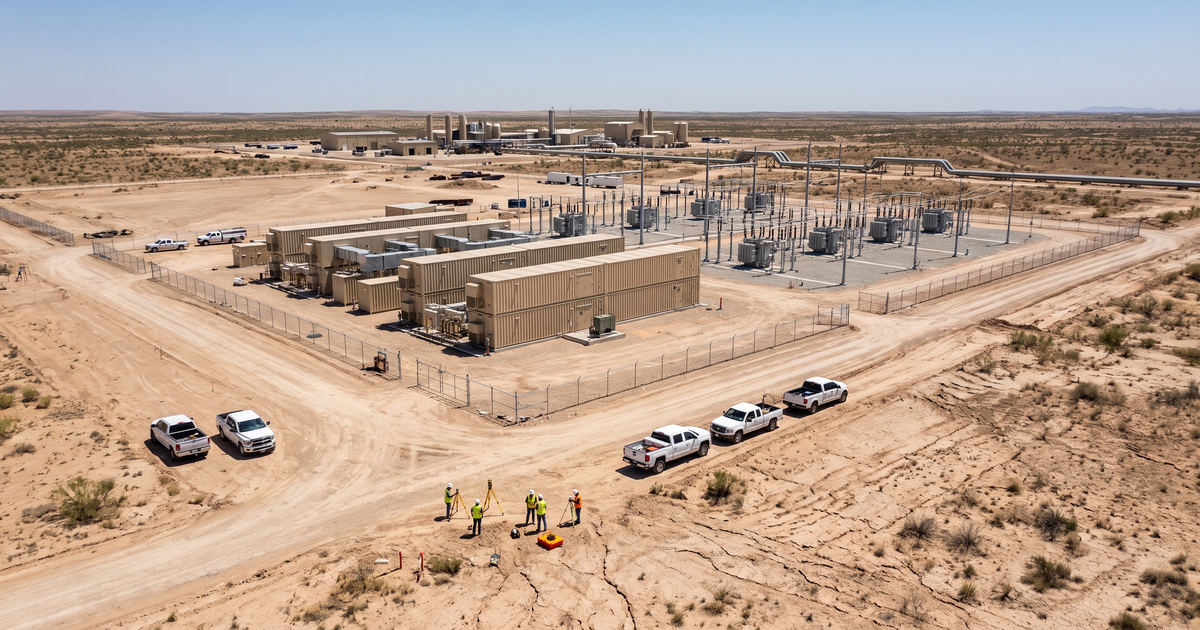
PowerBridge Alpha Digital Campus is today's LVN AI/data-center construction watch because the reviewed source set has a named developer, a named power partner, a named landowner, a county-level location, and a clear powered-campus scale. Liberty Energy and PowerBridge announced a strategic joint venture tied to Alpha Digital Campus in West Texas, describing a planned 2 GW powered data-center campus with an initial phase expected to include more than 300 MW of generation capacity.
The land side is also source-backed. LandBridge announced an agreement with PowerBridge giving PowerBridge an option to lease about 3,400 acres in Reeves County, Texas near the Waha natural gas hub for Alpha Digital Campus and associated power and digital infrastructure. That makes this more useful than a generic AI power headline: there is enough location and entity structure to track permits, generation filings, interconnection movement, site work, and eventually low-voltage package names.
PowerBridge describes its integrated digital-campus model around onsite power generation, high-voltage electrical infrastructure, land, water, and fiber for hyperscale and AI workloads. That is the important construction read. This is not just a future server-room story. It is a large West Texas power-plus-data-center platform where utility, generation, substation, civil, fiber, controls, security, and commissioning signals should appear before the actual data-hall specialty awards become public.
| Item | Source-backed detail | LVN read |
|---|---|---|
| Project | PowerBridge Alpha Digital Campus | Planned powered AI/data-center campus in Reeves County, Texas. |
| Land | Option to lease about 3,400 acres near Waha | Large enough for phased data-center and power infrastructure. |
| Power | 2 GW planned powered campus; 300+ MW initial generation phase | Power capacity context, not disclosed building-level IT load. |
| Timing | First power targeted for Q4 2027; deployment through H1 2028 | Watch filings and early infrastructure packages now. |
| Stage | Planned / JV and lease-development stage | Track entitlement, generation, interconnection, and site-prep proof. |
Data Center Dynamics and Midland Reporter-Telegram both add current trade and regional context for the PowerBridge-Liberty-LandBridge project family. The useful public stance is still conservative: the 2 GW figure is planned powered-campus or co-located generation context, the first phase is expected generation capacity above 300 MW, and reviewed sources do not disclose building-level IT critical load, data-center building count, square footage, tenant/customer, or specialty package holders.
The named company map is clear enough for Signal. The JV announcement source-backs PowerBridge as developer and Liberty Energy as power partner, with Liberty Power Innovations expected to design, develop, and operate scalable modular power generation architecture. LandBridge is source-backed as the landowner and lease-development counterparty, and Five Point Infrastructure is relevant as LandBridge's infrastructure-backer context. Reeves County is the local jurisdiction to monitor.
| Company / agency | Role | Evidence |
|---|---|---|
| PowerBridge LLC | Developer | JV announcement |
| Liberty Energy | Power partner | JV announcement and company site |
| Liberty Power Innovations | Power-generation vendor / operator context | JV announcement and company site |
| LandBridge | Landowner / lease-development counterparty | LandBridge release |
| Reeves County | Local jurisdiction | LandBridge release |
For low-voltage contractors, the early opportunity is not a named cabling package yet. It is a watch lane. A 3,400-acre powered campus can create work around fiber entrances, carrier route coordination, OSP conduit, duct banks, MMRs, access roads, security entrances, camera and access-control planning, fire alarm interfaces, controls networks, EPMS/BMS integration, substation communications, generator controls, grounding, test reporting, and commissioning documentation.
| System | Why it matters | Watch signal |
|---|---|---|
| Fiber / OSP | Large rural powered campuses need diverse connectivity, duct banks, vaults, and carrier coordination. | Fiber route notices, easements, conduit work, carrier references, MMR language. |
| Structured cabling | Data halls and support buildings eventually need repeatable pathways, labeling, and certification. | Building filings, data-hall packages, rack/pathway specs, closeout standards. |
| Access control / CCTV | Remote high-value power and data infrastructure needs controlled entrances and perimeter visibility. | Gate, fence, camera, VMS, badging, and security-integrator references. |
| Fire alarm | Generation yards, support buildings, and data halls will require AHJ coordination and monitoring interfaces. | Plan reviews, FA permits, suppression interfaces, acceptance-test language. |
| BMS / EPMS | PowerBridge's model depends on generation, electrical infrastructure, cooling, and power monitoring. | Controls, SCADA, EPMS/BMS, point-list, alarm, and integration packages. |
| Grounding / commissioning | High-voltage, generation, and mission-critical turnover depend on clean testing and documentation. | Ground grid, bonding, commissioning-agent, QA/QC, and turnover requirements. |
The jobs-and-skills angle should stay practical. Reviewed sources do not give construction job counts or permanent operations jobs, so this post should not invent them. The skills layer is still obvious for LVN: data-center safety onboarding, OSP fiber discipline, copper and fiber testing, clean labeling, cable-tray coordination, lift/site readiness, grounding and bonding, controls coordination, fire alarm acceptance testing, camera and access-control QA, commissioning support, redlines, and closeout documentation.
The West Texas location changes the contractor-read. Reeves County and the Waha gas hub point to a power-first infrastructure environment. Low-voltage firms should watch the same signals that energy and civil teams watch: generation permits, air filings, interconnection requests, private electrical network references, land-development hearings, county infrastructure records, temporary construction facilities, security perimeter work, and fiber-route movement. By the time a formal structured-cabling bid is public, the upstream project team may already be taking shape.
The practical sequence is likely to start outside the data hall. A powered campus of this type has to solve land access, temporary construction communications, security perimeters, construction trailers, access roads, generation yards, high-voltage equipment areas, utility yards, grounding grids, and backbone routes before final IT spaces are turned over. That matters because early infrastructure contractors often see the project controls, safety requirements, documentation cadence, and owner preferences before later specialty trades enter the site.
Fiber should be treated as a first-class watch item. PowerBridge's own campus framing includes fiber, and a remote West Texas AI campus cannot function without diverse long-haul connectivity and resilient campus distribution. The source set does not name carriers or fiber vendors yet, so LVN should not guess. The right signals are easements, railroad or highway crossings if they appear, county road work, utility pole or conduit references, carrier construction notices, outside-plant job posts, MMR language, and any public reference to diverse entrances or redundant routes.
Controls and monitoring deserve the same attention. Liberty Power Innovations is source-backed as the generation architecture party, which means the first public technical details may show up around modular generation, switchgear, SCADA, EPMS, BMS, alarms, telemetry, network segmentation, and commissioning rather than around server cabinets. Low-voltage and controls firms that understand power-generation environments as well as data-center turnover can use this kind of project as a bridge between traditional industrial work and mission-critical AI infrastructure.
Security will likely be broader than a standard office access-control package. A 3,400-acre power and data campus needs perimeter awareness, controlled gates, laydown-yard management, construction badging, visitor workflows, camera coverage, equipment-yard visibility, and eventual data-hall security boundaries. The public record does not name an integrator, but the security system footprint is exactly why LVN should track county permits, job postings, integrator case studies, and contractor photography as the site moves from planning into field activity.
The strongest follow-up is to connect the energy-side record to construction-side evidence. If ERCOT, TCEQ, PUCT, county, or generation filings name engineering firms, equipment packages, substation work, temporary-power contractors, or civil scopes, those names become the first map of the project team. Later, if building filings disclose an architect, engineer, GC, or data-center shell packages, LVN can update the same Signal row instead of creating a second disconnected headline.
This also creates a business-development angle for LVN. PowerBridge, Liberty, Liberty Power Innovations, LandBridge, and regional contractors can be approached with a source-backed article that says exactly what is known and exactly what is not. The offer is not rumor traffic. The offer is a public record that can be updated when contractor names, package channels, safety requirements, workforce needs, or prequalification paths become source-backed.
The contractor stance needs discipline. No reviewed owner, partner, landowner, trade, or local source names a GC, EPCM, engineer of record, electrical contractor, low-voltage contractor, fiber/OSP contractor, structured-cabling contractor, security integrator, fire alarm contractor, BAS/BMS/EPMS vendor, DAS/networking contractor, grounding contractor, or commissioning agent. Those are unknown fields. The article should preserve those unknowns instead of turning watch items into fake awards.
The capacity stance needs the same discipline. The headline number is 2 GW, but the reviewed primary sources frame that as a planned powered campus or co-located generation context. The initial 300-plus MW value is expected generation capacity. Neither value is building-level IT critical load. That distinction matters because low-voltage labor planning depends on actual buildings, data halls, and turnover phases, not just power scale.
The near-term watch list is narrow and useful: PowerBridge updates, Liberty Energy and Liberty Power Innovations updates, LandBridge lease-development milestones, Reeves County records, Pecos-area permits, ERCOT and Texas PUC references, TCEQ air or generation filings, interconnection records, plan-room channels, and job postings tied to Alpha Digital Campus, PowerBridge, Waha, Reeves County, or West Texas powered campuses. Those records should reveal the first names around EPC, civil, electrical, controls, site security, and later data-center low-voltage packages.
Alias control matters here. Track PowerBridge Alpha Digital Campus, Alpha Digital Campus, Liberty PowerBridge West Texas JV, LandBridge PowerBridge Reeves County, Pecos Alpha Digital Campus, Waha data center, Reeves County powered campus, and PowerBridge 2 GW campus. Keep it distinct from Chevron / Microsoft Project Kilby, Circe West Texas, IREN Sweetwater, Google / Intersect Meitner, New Era TCDC Odessa, and other Permian or West Texas power-adjacent AI campuses.
Bottom line: PowerBridge Alpha Digital Campus is a strong LVN Signal item because the public-source evidence points to a large, planned Reeves County powered campus before specialty contractor names are public. The useful move is to publish the watch record now, keep the 2 GW and 300-plus MW capacity language tied to power infrastructure, and track the first source-backed paths into fiber, security, fire alarm, controls, networking, grounding, and commissioning.
Join 35,000+ Low Voltage Pros
Get weekly permit updates, tool deals, job opportunities, and industry news. No spam, unsubscribe anytime.