
Join Low Voltage Nation — Find project opportunities and showcase your company to thousands of industry professionals
Edged US's three-building Project Atlas returns to South Whitehall review August 13 with about 1.48 million square feet, a reported 725 MW plan, a tentative four-year buildout, and major fiber, security, controls, fire, substation, and commissioning lanes still unawarded.
Edged US's Project Atlas is back in South Whitehall Township's public review queue today, August 13, 2026. The Township Planning Commission page lists Project Atlas, major plan 2025-109, among the next-meeting applicant submissions. The case concerns a planned three-building data-center campus near North Cedar Crest Boulevard, Mauch Chunk Road, and Orefield Road in the Allentown area. No final land-development approval or construction authorization is established by that listing.
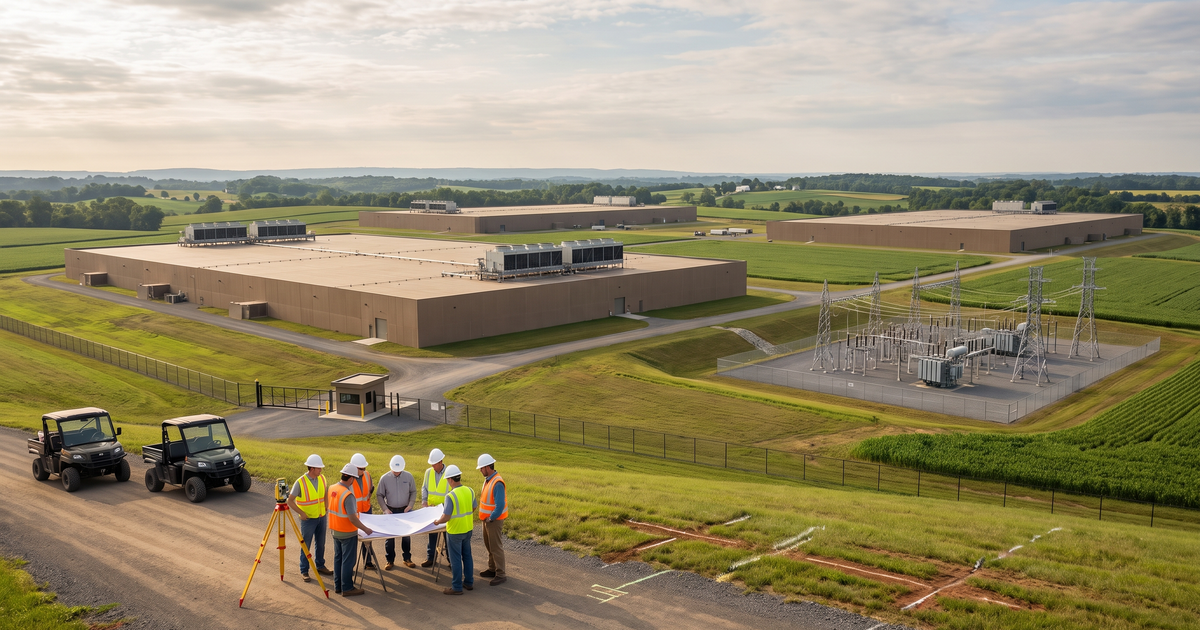
The current project is materially different from its earliest concept. The applicant's revised submission and the Township review packet describe three data-center buildings at 492,285 square feet each, plus supporting administration, warehouse, substation, security, road, utility, generator, stormwater, and landscape elements. That puts the three principal data-center buildings at about 1.48 million square feet. Data Center Dynamics reports a 725 MW campus plan, but public records reviewed by LVN do not establish building-level IT critical load, a committed utility-delivery schedule, or an energized first phase.
| Project fact | Current detail | Reporting boundary |
|---|---|---|
| Stage | Planned / preliminary review | Project Atlas remains in Township review. |
| Data-center buildings | 3 at 492,285 sq ft each | About 1.48M sq ft in the current submission. |
| Campus area | About 410 acres | Three-parcel project family. |
| Capacity | 725 MW plan reported | Building IT load and delivery milestones undisclosed. |
| Construction window | Nov. 2026-April 2030 | Applicant schedule is non-binding. |
| GC / EPCM | Undisclosed | No source-backed builder award reviewed. |
| Specialty trades | Undisclosed | No low-voltage package awards reviewed. |
The applicant's one-page anticipated construction schedule gives the most useful current sequencing signal. It models Building 1 from November 1, 2026 through December 28, 2028; Building 2 from November 2, 2027 through August 30, 2029; and Building 3 plus annex buildings from July 1, 2028 through April 30, 2030. The letter calls the schedule preliminary, non-binding, and dependent on final design, approvals, procurement, and other factors. Contractors should treat those dates as a pursuit clock, not a notice to proceed.
The public record also contains a live entitlement issue. The Township zoning review said the May submission lacked the recorded landowner consent needed for the proposed Planned Innovation, Research, and Technology overlay path. It also identified conditional-use and accessory-use questions. Those comments do not mean the project is dead. They show why the August review matters and why specialty contractors should wait for verified approvals, plan revisions, and a named delivery team before treating packages as executable.
Project Atlas's developer site identifies Edged US as the data-infrastructure developer and states that the plan uses closed-loop cooling with zero daily cooling-water consumption. It also says the project will fund the infrastructure needed to serve its power demand, requests no local tax abatements, and proposes dedicating 160 acres for the Jordan Creek Greenway. Those are applicant claims and commitments that still have to move through public review, final design, permits, construction, and commissioning.
| Organization | Source-backed role | Pursuit signal |
|---|---|---|
| Edged US | Developer / operator | Project updates, hiring, future procurement. |
| CDE Acquisitions | Applicant / purchaser | Land-development and entitlement filings. |
| Jeras Corporation | Current land owner | Landowner-consent and approval path. |
| Kimley-Horn | Engineering submission author | Site, utility, traffic, civil, fire-flow records. |
| PPL Electric | Utility / substation context | Easements, interconnection, delivery milestones. |
| South Whitehall | Planning authority | Review, conditions, permits, public record. |
Kimley-Horn is the clearest source-backed technical-team name. The Township's July engineering-submission folder attributes the site plans, utility plans, traffic study, sound study, fire-tank sizing, generator maintenance plan, environmental work, stormwater material, PPL easement coordination, and other supporting documents to Kimley-Horn. That evidence supports a broad civil and engineering-document role. It does not prove Kimley-Horn holds mission-critical technology design, general contracting, electrical construction, low-voltage integration, or commissioning.
PPL Electric is tied to the proposed substation and easement context in the current record, while Project Atlas says it will pay for the infrastructure required to serve the campus. The reviewed sources do not disclose a final point of interconnection, voltage, energization date, feeder arrangement, protection scheme, SCADA boundary, utility telecom path, metering design, or building-by-building capacity allocation. Those details will determine when substation controls, grounding, operational networking, and testing become real packages.
The developer's current economic case is substantial. The Project Atlas site estimates 3,390 construction jobs, about 250 permanent positions with average annual wages of $65,000 to $75,000, $2.9 billion in local construction-period economic activity, and $16.2 million in recurring annual tax revenue. Separate local planning coverage reported an almost $9 billion private-investment claim. LVN keeps those numbers separate: modeled economic activity, tax projections, jobs, and a developer investment estimate are not interchangeable with a filed construction contract value.
The August review is also a community-risk checkpoint. Local public-media coverage documents resident requests for a formal hearing and questions about generators, emissions, noise, traffic, power, water, and transparency. The July planning-review report says no action followed the July presentation. For contractors, this means entitlement conditions, acoustic controls, generator restrictions, air permitting, security buffering, emergency access, and public-safety interfaces may still reshape scope and schedule.
| Low-voltage lane | Confirmed signal | What to qualify |
|---|---|---|
| Fiber / OSP | Large multi-building campus and utility work | Carriers, routes, duct banks, splicing, testing. |
| Structured cabling | Three 492,285-sq-ft data buildings | Pathways, racks, labels, QA, turnover standard. |
| Access / CCTV | Controlled access and security fencing | Integrator, gates, VMS, credentials, acceptance. |
| Fire alarm | Fire-flow and fire-tank design records | AHJ criteria, detection, monitoring, interfaces. |
| BMS / EPMS | Closed-loop cooling and power infrastructure | Integrator, networks, point lists, sequences. |
| Substation controls | Onsite substation / PPL coordination | Protection, SCADA, utility telecom, testing. |
| Grounding | Campus electrical and telecom systems | Bonding matrix, test records, closeout. |
| Commissioning | Phased critical facilities through 2030 | Authority, scripts, integrated failure testing. |
Outside-plant scope begins with the campus road, utility, stormwater, substation, and security layout. A three-building campus needs coordinated telecom entrances, carrier routes, vaults, handholes, duct banks, road crossings, perimeter infrastructure, and phase boundaries. Public records confirm the civil and utility design context. They do not disclose carriers, strand counts, meet-me rooms, route diversity, splicing responsibility, or which contractor owns trenching, conduit, placement, restoration, and as-built documentation.
Inside the buildings, the current square footage points to a long-duration structured-cabling and facility-network program. Likely qualification areas include backbone and horizontal cabling, pathways, racks and cabinets, labeling, fiber and copper testing, controls and security networks, monitoring connections, time synchronization, and digital turnover. These are practical mission-critical lanes, not claimed Project Atlas awards. Final topology, standards, quantities, manufacturers, and installation boundaries remain undisclosed.
Security has direct site-plan support through controlled access and perimeter fencing. Future packages can include vehicle and pedestrian gates, visitor processing, access control, intercom, CCTV, video management, perimeter detection, badging, monitoring, and acceptance testing. The reviewed material does not name a security consultant, integrator, product stack, command center, or commissioning plan. Later architectural, security, fire, and deferred-submittal records should narrow the package.
Fire and life safety have unusually early public signals because the engineering file includes fire-flow analysis and fire-tank sizing. That creates future coordination among fire alarm, sprinkler monitoring, detection, HVAC shutdown, door release, emergency communications, generator and fuel monitoring, supervising stations, and public-safety response. System types, device counts, manufacturers, the authority having jurisdiction's final conditions, and the awarded contractor remain unresolved.
Controls scope will bridge Edged's closed-loop cooling design, the onsite power program, emergency generation, environmental monitoring, alarms, and phased data-center operations. Firms should watch for BMS, EPMS, PLC, leak-detection, fuel-system, generator, power-quality, metering, substation-communications, and operational-network specifications. Current sources establish the equipment categories and engineering work, but not controls architecture, vendors, point counts, cybersecurity rules, or integrator awards.
Commissioning will have to follow the campus phasing. Useful readiness includes fiber certification, OTDR and optical-loss records, structured-cabling QA, security acceptance, fire-alarm inspection, controls point-to-point checks, power-monitoring validation, alarm propagation, network-resilience testing, integrated failure modes, issue closure, training, and electronic turnover. The public schedule makes the sequence visible; it does not name a commissioning authority or package holder.
Trade firms should prepare for a formal prequalification path. Data-center owners and builders commonly screen for mission-critical references, safety performance, insurance, bonding, background requirements, manufacturer authorizations, calibrated test equipment, documentation quality, and the ability to staff multiple phases. Project Atlas has not published those requirements. The right move is to monitor Edged, Kimley-Horn, PPL, Township permits, regional plan rooms, union notices, and the eventual GC or EPCM for an actual bid-list channel.
Workforce preparation can start before awards. Fiber technicians should be ready for inspection and cleaning, fusion splicing, optical-loss testing, OTDR use, polarity management, bend-radius control, and electronic test records. Cabling crews need pathway coordination, high-density labeling, copper and fiber certification, and clean as-builts. Security, fire, and controls technicians need segmented-network fluency, point-to-point validation, cause-and-effect testing, issue tracking, and integrated commissioning discipline.
Useful training paths include BICSI optical-fiber training, BICSI copper training, FOA workforce resources, and OSHA outreach training. These are general readiness resources. No reviewed Project Atlas source requires those exact credentials, and the eventual owner, builder, integrators, and authorities may impose additional requirements.
The next useful records are the August 13 Commission discussion and any recommendation, revised Township comments, owner-consent or conditional-use filings, Board of Commissioners action, land-development approval, air and environmental permits, PPL interconnection and easement milestones, and construction permits. Company announcements should eventually identify the GC or EPCM, architect, mission-critical engineer, electrical contractor, structured-cabling and fiber teams, security and fire integrators, controls vendors, and commissioning authority.
Bottom line: Project Atlas is a high-confidence planned data-center project with a current three-building, approximately 1.48-million-square-foot submission, a reported 725 MW campus plan, a tentative November 2026-April 2030 construction window, and a public review milestone on August 13. Edged US, CDE Acquisitions, Jeras Corporation, Kimley-Horn, PPL Electric, and South Whitehall Township are source-backed participants. Final approvals, delivered power, building IT load, tenant, builder, specialty contractors, bid channels, and package dates remain open.
Join 35,000+ Low Voltage Pros
Get weekly permit updates, tool deals, job opportunities, and industry news. No spam, unsubscribe anytime.