
Join Low Voltage Nation — Find project opportunities and showcase your company to thousands of industry professionals
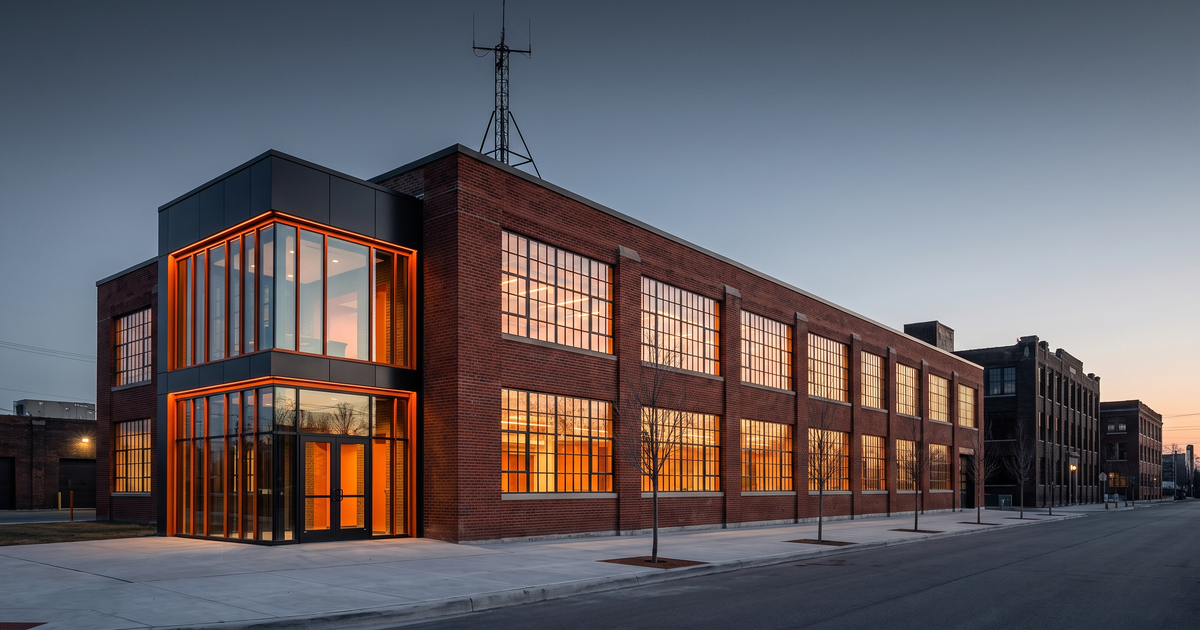
Detroit PBS is converting a century-old former General Motors engineering building in Milwaukee Junction into a television and radio campus — seven video production locations up from two, a 300-seat theater-style studio, and a performance space that works indoors and outdoors. Five low voltage systems and an estimated $1.4 million in LV work, on a job where SMPTE ST 2110, PTP timing, and technical grounding matter more than conference room AV experience.
Detroit PBS is turning a century-old General Motors engineering building into a television and radio campus — seven video production locations, a 300-seat theater-style studio, and a performance space that runs indoors and outdoors. Five low voltage systems and an estimated $1.4 million in LV work, on a job where broadcast credentials matter more than AV credentials.
Project Overview
Permit records filed with the City of Detroit describe a change of occupancy and use to Television Station, covering renovation of an existing one-story building plus an addition, to house a new performance space, studio, and offices for Detroit PBS. The tracked permit value is $10,368,776.
The building is at 234 Piquette Avenue in Detroit's Milwaukee Junction neighborhood — a century-old former General Motors engineering facility, near I-75, I-94, and Woodward. The station, which rebranded from Detroit Public Television to Detroit PBS in 2024, is moving its headquarters back into the city and consolidating more than 100 employees into roughly 50,000 square feet with parking for 120 vehicles. Reporting puts the broader media campus program at roughly $40 million, backed by lead philanthropic funding including $7.5 million from the Erb Family Foundation. Opening is targeted for Fall 2026.
The program is unusually dense for the square footage. Detroit PBS expands from two studios to seven video production locations, including a 300-seat theater-style studio and a performance studio designed to work both indoors and outdoors. The campus also houses 90.9 WRCJ radio production and broadcast, a journalism hub, arts performance space, and community events space.
| Project | Detroit PBS Media Campus — Studio & Performance Space |
| Location | 234 Piquette Ave, Milwaukee Junction, Detroit, MI |
| Permit Value | $10,368,776 |
| Campus Program | approximately $40 million |
| Building | ~50,000 sq ft, century-old former GM engineering facility |
| Production Space | 7 video locations (from 2), 300-seat theater studio, indoor/outdoor performance studio |
| Also Houses | 90.9 WRCJ radio production and broadcast |
| Opening | Fall 2026 |
| LV Score | 8/10 |
| Source | Detroit Building Permits |
Broadcast Is Not Conference Room AV
This is the thing to understand before deciding whether to chase a job like this.
Most low voltage and AV integrators build conference rooms, training rooms, and huddle spaces. A television station is a different discipline with its own standards, its own failure modes, and its own vocabulary. The gap is real enough that broadcast systems integration is largely a separate industry.
- Video moved to IP, and it is not ordinary IP. Modern facilities run SMPTE ST 2110, which carries video, audio, and ancillary data as separate uncompressed essence streams over a network. That means multicast design, precise bandwidth engineering, and switches specified for the job — not a general-purpose enterprise LAN with more ports.
- Timing is a system. ST 2110 depends on PTP (IEEE 1588) for sub-microsecond synchronization across every device. Grandmaster clocks, boundary clocks, and redundant timing paths are part of the design. Nothing about this exists in a corporate AV job.
- Redundancy is assumed, not optional. Broadcast facilities run diverse, physically separated red and blue signal paths so a single cable or switch failure does not take the station off air. That doubles pathway planning and demands documentation discipline.
- Technical grounding is separate. Studios carry a technical ground and bonding scheme distinct from the building's normal grounding, specifically to keep hum, noise, and ground loops out of audio and video. This is the same family of thinking LVN covered on the Mesa public safety facility, where radio sites ground to Motorola R56 rather than the NEC alone.
- Intercom and tally are their own systems. Party-line and matrix intercom, IFB, tally, and timing distribution tie every production position together. A control room that cannot talk to the floor is a control room that does not work.
If your reference projects are conference rooms, this is a different trade. If you have broadcast experience, the competitive field for this job in Detroit is very short.
Know What Is Not in Your Contract
The second recurring lesson — the same one that applies to public safety radio — is scope boundaries.
On broadcast projects, the technical equipment is usually owner-furnished: cameras and lenses, production switchers, video routers, master control, audio consoles, servers and storage, and often the studio lighting fixtures and grid. Public media organizations frequently buy this through separate capital campaigns, grants, or equipment-specific funding, and integrate it with a broadcast systems integrator rather than the construction contractor.
What is typically in the construction package is the infrastructure that equipment lands on: pathways and cable tray sized for broadcast bundles, technical rooms, structured cabling and fiber, the technical grounding and bonding system, coordination with clean power and UPS, security, fire detection, and the AV for the non-technical spaces — offices, community rooms, and lobby.
Pricing the cameras is how you lose money on a bid you never should have carried. Pricing the pathway, the grounding, and the coordination correctly is how you win the next one.
A Hundred-Year-Old Industrial Shell
Milwaukee Junction is the heart of Detroit's original auto manufacturing district — the Ford Piquette Avenue Plant, where the Model T was built, is on the same street. Adaptive reuse of a century-old GM engineering building brings its own constraints:
- Change of occupancy is on the permit. That phrase triggers code review against current requirements rather than grandfathered ones, which drives fire alarm, egress, and accessibility scope that a straight renovation might avoid.
- As-builts are unreliable. A hundred years of industrial modification means structure, existing services, and concealed conditions should be verified, not assumed. Budget investigation time.
- Heavy structure fights pathway. Thick concrete and structural steel from an engineering plant do not accept new penetrations casually, and broadcast bundles are large. Pathway coordination has to happen early, because a studio's cable volume is not something you route around later.
- Acoustic isolation is structural. Studios need isolation from street noise, from the freeways nearby, and from each other. Seven production locations in 50,000 square feet means the wall and floor assemblies are doing acoustic work, and your penetrations have to preserve it.
The Outdoor Performance Studio
The indoor-outdoor performance studio deserves its own note, because outdoor broadcast infrastructure is a distinct problem.
Permanent exterior production space needs weather-rated camera positions with power and signal, tie-in points for audio and intercom, lighting circuits and control, environmental protection for connectors that will be opened and closed repeatedly, and a clear boundary between permanent infrastructure and the temporary rigging a production brings with it. Done well, a touring crew plugs in and works. Done poorly, every outdoor event becomes a cable run across a parking lot.
Low Voltage Systems Breakdown
| System | Category | Scope Description | Complexity |
|---|---|---|---|
| Audio/Visual | AV / Broadcast | The dominant scope, and it splits in two. Broadcast production AV across seven video locations, the 300-seat theater studio, and the outdoor performance space — plus conventional AV for offices, community rooms, and public areas. The theater studio in particular is a hybrid: theatrical lighting and sound for a live audience, layered on top of a working television studio. | Very High |
| Structured Cabling | Data/Voice | Broadcast-grade infrastructure: fiber and copper to seven production locations, technical rooms, control rooms, and the radio side for WRCJ. Diverse red/blue pathways, cable tray sized for broadcast bundles, and labeling and as-built rigor far beyond a commercial job — engineers troubleshoot live on air and cannot guess. | Very High |
| Fire Alarm | Life Safety | Change of occupancy to a television station with a 300-seat assembly space in a century-old shell. Assembly occupancy notification, coordination with a building that must go quiet during production, and detection in technical rooms full of equipment. Detroit AHJ review on an adaptive reuse adds process time. | High |
| Access Control | Security | Layered zones: public lobby and community space, offices, studio floors, control rooms, technical and equipment rooms, and the loading area productions use. Broadcast facilities also carry a real physical security posture — a station going off air because someone walked into a technical room is a genuine risk. | High |
| CCTV | Security | Perimeter, parking for 120 vehicles, entries, loading, corridors, and the outdoor performance area. Note this is security video, entirely separate from the production video system — a distinction worth making explicit in a facility where "camera" means two different things. | Medium-High |
Estimated Low Voltage Value
| Permit Value | $10,368,776 |
| Estimated LV Percentage | 12% (technical / media facility) |
| System Count Multiplier | 1.15x (5 systems) |
| Estimated LV Contract Value | approximately $1.4 million |
| Planning Range | $1.1 million – $2.0 million |
The 12% base sits above LVN's 6–7% institutional benchmark because a media facility is mostly technical space — seven production locations, control rooms, and a theater studio inside 50,000 square feet leaves relatively little conventional office. It sits well below the 25% LVN used for the Florida Theatre systems renovation, because this project includes a building addition, a full renovation, and offices rather than being purely a systems upgrade.
Read that figure as the construction low voltage package only. With broadcast equipment owner-furnished and the wider campus program around $40 million, total technology spend on this facility is considerably higher than $1.4 million — it is just not all bought through the same contract.
Skills and Certifications Required
| System | Key Certifications | Critical Skills |
|---|---|---|
| Broadcast Infrastructure | SBE certifications (CBT/CBNT/CBNE), SMPTE ST 2110 and PTP literacy | IP video network design, multicast and bandwidth engineering, timing distribution, red/blue path diversity, technical grounding |
| Structured Cabling | BICSI RCDD, INSTC, INSTF, FOA CFOT | Broadcast pathway sizing, fiber to production locations, diverse routing, obsessive labeling and as-builts |
| Theatrical / Studio AV | AVIXA CTS, CTS-I, CTS-D; ETCP for studio lighting and rigging | Studio lighting grid and control, live-audience sound, hybrid theater-and-studio design, outdoor production infrastructure |
| Fire Alarm | NICET Fire Alarm Level II+, Michigan licensing | Assembly occupancy notification, change-of-occupancy code review, technical room detection, AHJ coordination on adaptive reuse |
| Security | ASIS PSP, manufacturer certification (Genetec, Lenel, Axis) | Zoned credentialing for technical spaces, separation of security video from production video, loading and event access |
Market Signal
Public media is quietly a recurring low voltage market, and the driver is a technology transition rather than growth. Stations built their facilities around SDI baseband video, and the industry is migrating to IP. That migration is hard to do inside an existing plant while staying on air, which is why a number of stations are choosing to build or renovate a new facility instead — and every one of those projects is a systems-led job.
Detroit PBS is also a specific kind of client worth understanding. Public media organizations fund capital projects through philanthropy and grants, which means phased, funding-dependent procurement — the Erb Family Foundation's $7.5 million is named lead funding on a roughly $40 million campus. That pattern rewards contractors who can work with an owner whose schedule is tied to fundraising milestones, and it usually produces follow-on work as later phases get funded.
For Detroit specifically, this is the second Milwaukee Junction-adjacent adaptive reuse LVN has tracked in the region this summer, alongside the BAMF Health and Henry Ford theranostics center in the Gratiot district. Detroit is converting its industrial building stock into specialized technical facilities — medical, media, research — and each conversion is a change-of-occupancy job with heavy systems content and unreliable as-builts. That is a repeatable capability, not a one-off.
Find Projects Like This on Signal
LVN Signal tracks thousands of construction projects with low voltage opportunities across the country. Filter by city, system type, and project value to find your next bid.
Join 35,000+ Low Voltage Pros
Get weekly permit updates, tool deals, job opportunities, and industry news. No spam, unsubscribe anytime.