
Join Low Voltage Nation — Find project opportunities and showcase your company to thousands of industry professionals
A $21.5 million tenant build-out in downtown Detroit will house the BAMF Health and Henry Ford Health Comprehensive Theranostics Center, requiring five low voltage systems with an estimated $1.6 million in LV work. Cyclotrons, hot cells, and a commercial radiopharmacy turn access control and surveillance into regulated materials security — and no LV subcontractor has been named yet.
A $21.5 million medical fit-out in downtown Detroit requires five low voltage systems, creating an estimated $1.6 million opportunity — and it is unlike any clinic build-out on the board in Michigan right now, because this one stores and manufactures radioactive material.
Project Overview
Permit records filed with the City of Detroit show a tenant build-out of 40,212 square feet of first-floor space at 1326 Saint Antoine Street, valued at $21,472,673. The permit describes the space plainly: "Medical Office (Imaging, Theranostics, & RadioPharmacy)." That one line hides one of the most technically demanding low voltage scopes in the Midwest.
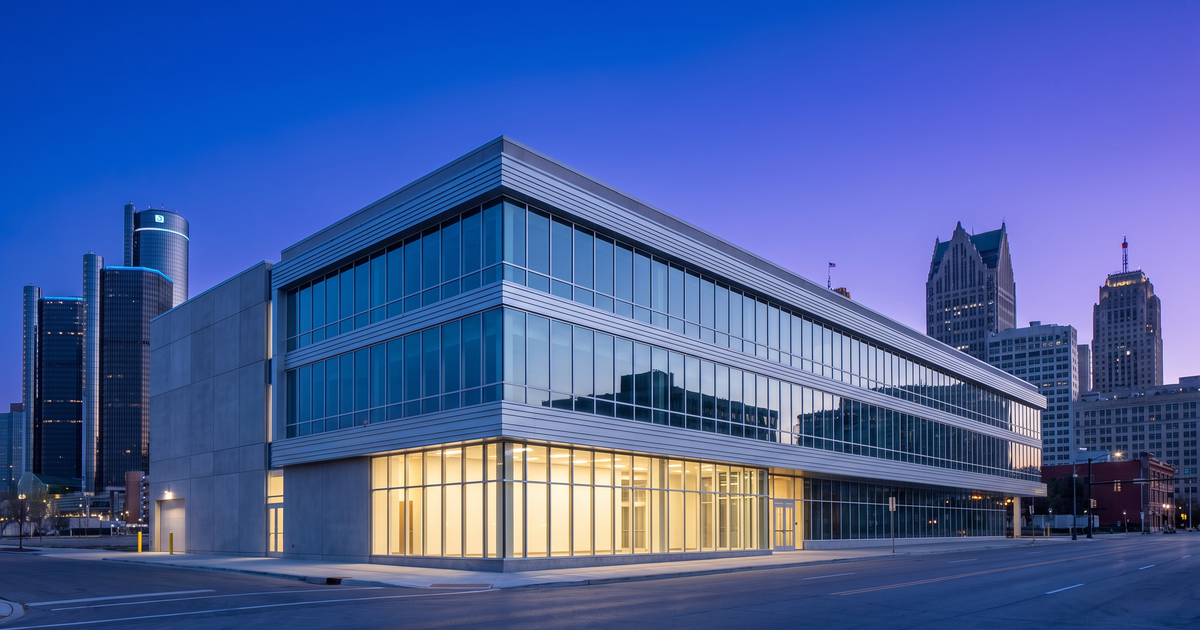
The address is the former Wayne County "fail jail" site at the east entrance to downtown Detroit — 14 acres that sat vacant for a decade. Bedrock broke ground on the two-story, roughly 90,000-square-foot Gratiot Life Sciences Building there on April 14, 2026, with completion targeted for the end of 2027. The ground floor is the anchor: a Comprehensive Theranostics Center operated as a joint venture between BAMF Health and Henry Ford Health.
Theranostics combines diagnosis and treatment using radiopharmaceuticals — radioactive compounds that find cancer cells and then destroy them. The Detroit center is announced as roughly 45,000 square feet of program across three functions: a molecular imaging clinic, a molecular therapy clinic, and a commercial manufacturing radiopharmacy. Michigan Economic Development Corporation filings put the equipment list on record: MRI machines, PET/CT scanners, hot cells, and cyclotrons. The state committed a $1.5 million Michigan Business Development Program grant and a 15-year sales and use tax exemption against $45 million of eligible personal property, tied to a minimum capital investment of $93,756,533 and up to 90 new jobs.
| Project | Comprehensive Theranostics Center — Gratiot Life Sciences Building |
| Location | 1326 Saint Antoine St, Detroit, MI |
| Permit Value | $21,472,673 (first-floor tenant build-out) |
| Scope | 40,212 sq ft interior fit-out |
| Building | 2 stories, ~90,000 sq ft (Bedrock) |
| Project Type | Healthcare / Life Sciences |
| Status | Active — shell under construction, complete end of 2027 |
| LV Score | 8/10 |
| Source | Detroit Building Permits (BSEED) |
Key Players
The design and preconstruction team is fully named in public project records. The construction trades are not — which is exactly why this project is worth tracking now.
| Role | Company | Details |
|---|---|---|
| Developer | Bedrock | Detroit's largest downtown developer. The Gratiot site is pitched as the first building of a 14-acre innovation district. |
| Operator / Tenant | BAMF Health | Grand Rapids-based theranostics company. Detroit is its second comprehensive center after its 2022 flagship. |
| Health System Partner | Henry Ford Health | Joint venture partner operating clinical and research programs on the ground floor. |
| Architect | Perkins&Will | Architect and landscape architect of record for the Life Sciences Building. |
| MEP, Fire Protection & Technology Engineer | Affiliated Engineers (AEI) | The named technology engineer — meaning AEI writes the Division 27 and 28 specifications this project will be bid against. |
| Structural Engineer | WSP | Structural engineering for the two-story shell. |
| Civil Engineer | Giffels Webster | Civil engineering and site work on the former jail parcel. |
| Preconstruction | Turner | Listed on the project team for preconstruction services. |
No low voltage, security, or AV subcontractor has been publicly named. For contractors in southeast Michigan, that is the headline: the design authority is set, the shell is out of the ground, and the technology package is still in front of the buyout.
Why This Is Not a Normal Medical Office Fit-Out
At $534 per square foot, the permit value alone signals that this is not drywall and data drops. A commercial radiopharmacy with cyclotrons and hot cells means licensed radioactive material is manufactured, stored, and administered on site. That single fact reshapes every low voltage system in the building.
Shielding changes the pathway design. PET/CT vaults, hot cells, and therapy suites are built with lead-lined or high-density concrete walls. Every cable penetration through a shielded barrier is a potential radiation leak path, which means straight-through conduit is not acceptable. Penetrations get offset, doglegged, or sleeved with shielding collars, and their locations are coordinated with the physicist — not field-decided by the installer. Cable routing that would be trivial in a standard clinic becomes a submittal item.
Security becomes materials security. Facilities holding quantities of radioactive material at NRC Category 1 or 2 thresholds fall under 10 CFR Part 37 Increased Controls. Access control and video surveillance stop being convenience systems and become part of a regulated security plan: two-barrier access to material storage, monitored intrusion detection, immediate detection and assessment of unauthorized access, response coordination with local law enforcement, and personnel trustworthiness controls tied to credential issuance. Documentation, retention periods, and testing intervals are all prescribed.
Patients become radiation sources. After radioligand therapy, patients emit radiation for a period of time. Therapy suites need nurse call and communication that lets staff monitor and interact without entering the room unnecessarily — intercom, two-way audio, and camera coverage designed for dose-minimizing workflow rather than general clinical convenience.
Low Voltage Systems Breakdown
Signal tracks five low voltage systems on this project, spanning clinical communication, security, data infrastructure, and audiovisual. The system count is modest; the complexity per system is not.
| System | Category | Scope Description | Complexity |
|---|---|---|---|
| Structured Cabling | Data/Voice | Backbone and horizontal cabling for imaging modalities, PACS transport, radiopharmacy production systems, and clinical workstations. PET/CT and MRI generate large datasets that move to archive continuously, so uplink sizing and pathway redundancy matter. Routing must respect shielded-barrier penetration details and MRI magnetic field zones. | High |
| Access Control | Security | Layered credential control across the clinical suite, therapy rooms, hot cell area, cyclotron vault, and radiopharmacy cleanroom. Interlocks, anti-passback, and audited two-barrier access to licensed material areas. Credentialing tied to trustworthiness and reliability determinations under NRC Increased Controls. | High |
| CCTV / Video Surveillance | Security | Coverage of material storage and transfer paths, vault entries, loading and shipping areas, and therapy corridors. Requirements lean toward immediate assessment capability and defined retention rather than general-purpose recording. Camera placement inside shielded rooms requires coordinated cable entry. | High |
| Nurse Call | Life Safety / Clinical | Call, staff-assist, and code stations across imaging bays, infusion and therapy suites, and recovery areas. In therapy rooms the system pairs with two-way audio so staff can respond without unnecessary occupancy time near a dosed patient. | Medium-High |
| Audio/Visual | AV | Consultation and reading room displays, multidisciplinary tumor board conferencing, in-suite patient communication and distraction audio, digital signage and wayfinding. Research programs in the building add collaboration space AV to the scope. | Medium |
Estimated Low Voltage Value
Signal does not carry a contracted low voltage value for this permit, so the figure below is estimated from industry benchmarks for healthcare construction, adjusted for system count.
| Total Project Value | $21,472,673 |
| Estimated LV Percentage | 6.5% (healthcare midpoint) |
| System Count Multiplier | 1.15x (5 systems) |
| Estimated LV Contract Value | approximately $1.6 million |
The effective rate of roughly 7.5 percent sits toward the high end of the 5 to 8 percent healthcare range, and that is deliberate. Specialized nuclear medicine space carries a heavier proportional technology load than a general medical office: more device connectivity per square foot, a regulated security system, and installation labor that is slowed by shielding coordination and cleanroom protocols. Contractors pricing this as a standard clinic fit-out will be low, and will find out during coordination.
A reasonable split puts structured cabling near $400,000 to $500,000, the combined access control and surveillance package in the $500,000 to $600,000 range given the regulated scope, nurse call and clinical communication around $200,000, and AV in the $250,000 to $350,000 band. Those are directional numbers for bid planning, not a takeoff.
Skills and Certifications Required
This project rewards a contractor who can prove healthcare and regulated-facility experience on paper, not just cabling competence.
| System | Key Certifications | Critical Skills |
|---|---|---|
| Structured Cabling | BICSI RCDD, BICSI INSTC/INSTF, manufacturer certification (Panduit, CommScope, Leviton) | Cat6A and fiber termination, Fluke DSX certification, shielded-barrier penetration coordination, MRI zone awareness, pathway design |
| Access Control | ASIS PSP, manufacturer certification (Genetec, Lenel, Software House, HID) | Interlock and two-barrier design, audited credential management, door hardware integration, IP networking, regulated documentation |
| CCTV | Manufacturer certification (Axis, Avigilon, Milestone, Genetec) | Assessment-grade camera placement, retention and storage sizing, PoE design, VMS configuration, integration with access events |
| Nurse Call | Manufacturer certification (Rauland, Hill-Rom, Ascom, Jeron), UL 1069 familiarity | Clinical workflow design, staff station configuration, two-way audio, integration with paging and mobile devices |
| Audio/Visual | AVIXA CTS, CTS-I, CTS-D; manufacturer certification (Crestron, Extron, Q-SYS, Biamp) | Display and speaker layout, DSP configuration, AV-over-IP, conferencing integration, clinical-grade image handling |
Beyond the system certifications, three credentials move a bidder to the front of the list here. ICRA training matters because the building will be occupied and operational in phases. Familiarity with NRC 10 CFR Part 37 Increased Controls is what separates a security integrator who can support the license from one who cannot. And any technician working in the imaging and radiopharmacy areas will need site-specific radiation safety training and dosimetry participation.
Entry-level technicians with BICSI Installer 1 can support rough-in, device mounting, and terminations in non-restricted areas. Mid-level technicians handle system wiring, testing, and commissioning. Senior staff with an RCDD and a manufacturer-certified security lead will carry the coordination load — and on this job, coordination is most of the job.
Contractors should verify their Michigan licensing is current before pursuing this work. Michigan regulates fire alarm and security-related low voltage work through state licensing, and Detroit permitting adds its own review path through BSEED.
Market Signal
Detroit is in the middle of the largest healthcare and life sciences construction cycle in its modern history, and this permit is the tell. Henry Ford Health is executing a roughly $3 billion "Future of Health" expansion in New Center. Wayne State University is building a $200 million Health Sciences Research Building in Midtown. Now Bedrock has broken ground on the first structure of a planned 14-acre innovation district at the east edge of downtown, with a 220,000-square-foot life sciences innovation building as the eventual focal point.
Three of those programs sit within a few miles of each other. For low voltage contractors, that concentration is the opportunity — not because any single project is enormous, but because the same institutional owners, the same design engineers, and the same construction managers will be buying technology packages repeatedly for the rest of the decade. The specifications on the Gratiot building will look familiar on the next one.
There is also a specialization signal worth reading. Radiopharmaceutical therapy is one of the fastest-growing areas in oncology, and every comprehensive theranostics center built in the United States will need the same regulated security architecture, the same shielded-pathway discipline, and the same clinical communication design. There are very few low voltage contractors in the country who have done this work. The ones who do it in Detroit will have a credential that travels.
The practical read for a southeast Michigan integrator: the shell completes at the end of 2027, the design engineer is set, and the technology buyout for a $21.5 million fit-out has not been publicly awarded. That is a live window, and it is attached to a developer with 14 acres of pipeline behind it.
Find Projects Like This on Signal
LVN Signal tracks thousands of construction projects with low voltage opportunities across the country. Filter by city, system type, and project value to find your next bid.
Join 35,000+ Low Voltage Pros
Get weekly permit updates, tool deals, job opportunities, and industry news. No spam, unsubscribe anytime.