
Join Low Voltage Nation — Find project opportunities and showcase your company to thousands of industry professionals
Serverfarm's $6.6 billion Clarksville campus is under construction with Nabholz leading the build, first-building packages in motion, and major fiber, security, fire, controls, utility, and commissioning lanes still requiring award checks.
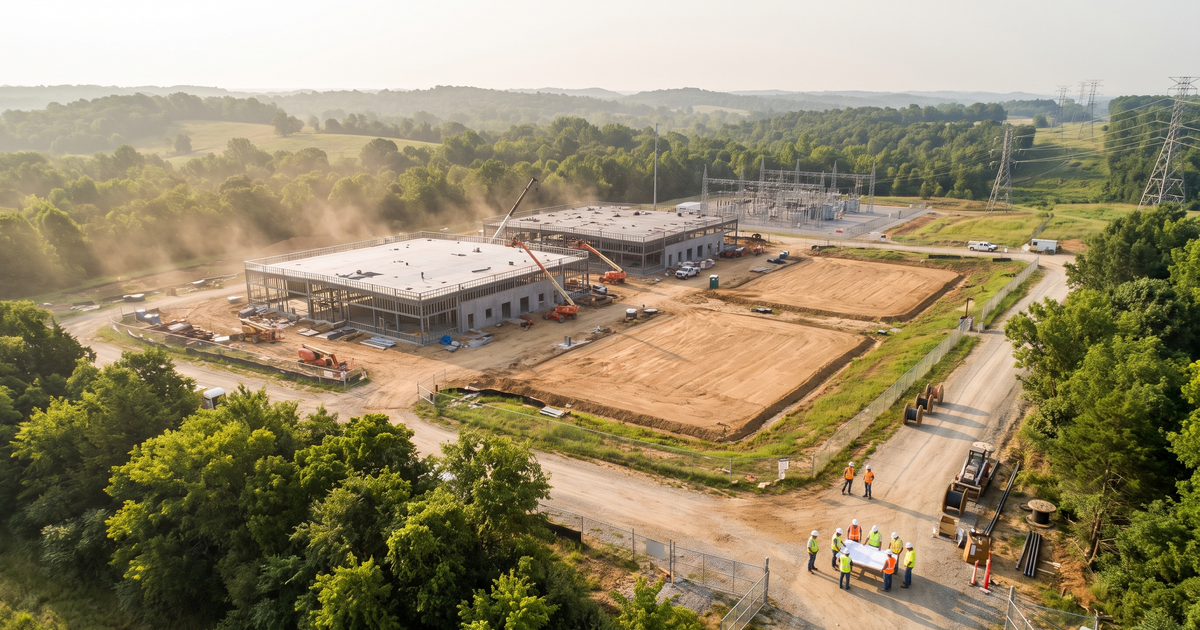
Serverfarm's ARK campus in Clarksville, Arkansas, is one of the clearest active data-center construction pursuits in the region because the public record now connects an owner, a construction manager, design firms, utility work, air permitting, and first-phase building packages. Serverfarm's current project page identifies ARK1 through ARK4, says site preparation is underway, and targets completion of the first two buildings by January 2028.
The construction status is source-backed but still needs building-by-building discipline. July site reporting documented clearing, a crane, and active groundwork. Current permit-based reporting says work has started on the first four buildings. That does not prove ARK1, ARK2, ARK3, and ARK4 have reached the same vertical, enclosure, MEP, or commissioning milestone. Trade firms should qualify each building and package separately.
| Project fact | Current detail | Boundary |
|---|---|---|
| Stage | Under construction | Milestones vary by building. |
| Named buildings | ARK1 through ARK4 | First two target Jan. 2028. |
| Building specification | 72 MW IT / 300,000 sq ft | Do not infer a campus total. |
| Connectivity | 4 POEs / multiple carriers | Routes and providers undisclosed. |
| Investment | $6.6B owner estimate | Bond ceilings are separate. |
| Builder | Nabholz | Current packages need recheck. |
Scale needs the same care. Serverfarm publishes a 72 MW IT and 300,000-square-foot building specification on the ARK page, along with a 1.3-or-lower design PUE, air-cooled closed-loop cooling, four points of entry, and multiple fiber providers. LVN does not multiply those values into a verified 288 MW or 1.2-million-square-foot campus total because the owner page does not explicitly state those aggregates.
A separate current report based on City documents says each first-phase building may draw about 108 MW. That figure can include more than delivered IT critical load, so it should remain distinct from Serverfarm's 72 MW IT specification. The same rule applies to the 18 MW construction-power arrangement in Clarksville Connected Utilities records: it is an interim construction supply signal, not campus production capacity.
The power story expanded again in August. Arkansas Democrat-Gazette reporting on a pending Solaris Resolute Title V application describes an adjacent 660 MW plant built around 40 16.5 MW simple-cycle natural-gas turbines, plus line heaters and limited emergency diesel equipment. That is a separately permitted power project. It is not a 660 MW IT-load disclosure, it is not a final issued air permit, and it should not be collapsed into the data-center backup-generator scope.
The data-center side also has its own active air-review track. The SF ARK1 public notice for AFIN 36-00544 says the new-air-permit application was declared administratively complete June 22, 2026 and moved into technical review. Contractors should monitor the Arkansas DEQ applications page for draft permits, equipment schedules, operating limits, noise-related conditions, and construction or testing milestones that affect generator controls, alarm interfaces, communications, and commissioning.
Financing headlines also require separation. Serverfarm estimates $6.6 billion of investment for the Clarksville campus. The City's SF ARK1 and Hatchbo notices describe up to $5 billion for land, buildings, and related facilities and up to $50 billion for equipment and related property. Those are conduit-revenue-bond authorization ceilings. They are not a $55 billion construction-cost claim, and the notices do not make the City responsible for repaying private project debt.
| Organization | Source-backed role | Pursuit signal |
|---|---|---|
| Serverfarm | Developer / owner / operator | Building plans, hiring, operations. |
| SF ARK1 | Permit applicant / bond lessee | Permits and project filings. |
| Nabholz | CM / GC / bid administrator | Addenda, awards, prequalification. |
| kW Mission Critical | MEP, fire, life safety, ICT | Design and deferred submittals. |
| Goodwyn Mills Cawood | Site civil engineer | Utilities, grading, OSP interfaces. |
| CCU | Utility / construction power | Transmission and substation work. |
| Solaris Resolute | Adjacent power applicant | Generation and controls permits. |
Nabholz is the most important contractor name for near-term pursuit. A February 2026 bid bulletin indexed from its Clarksville plan room names Nabholz as construction manager, general contractor, and bid administrator. The record identified Building 1 concrete; Buildings 1 through 3 mechanical and plumbing, fire-protection, and electrical packages; and lump-sum bidding for remaining scopes. The direct bulletin and drawing links are now retired with HTTP 404 responses, so LVN treats them as archived evidence and does not describe the February bid window as currently open. Nabholz's mission-critical profile is the current company contact surface.
Indexed drawings identify Goodwyn Mills Cawood on site-civil design and kW Mission Critical Engineering on mission-critical MEP, fire/life-safety, and ICT design. The drawings support those roles and show the design team had reached a 60-percent package stage in late 2025 and early 2026. They do not establish awarded electrical, structured-cabling, fiber, security, fire-alarm, controls, DAS, networking, grounding, or commissioning subcontractors.
That distinction creates the opportunity. The project already has enough design and construction evidence to justify outreach, while the reviewed record still leaves the specialty execution map unresolved. The useful questions are which bid packages were awarded, which scopes remain with the GC or electrical contractor, which deferred submittals are moving, and what onboarding channel Nabholz is using for Buildings 1 through 4.
| Low-voltage lane | Confirmed signal | What to qualify |
|---|---|---|
| Fiber / OSP | 4 POEs and multiple providers | Routes, vaults, carriers, splicing. |
| Structured cabling | ICT design and data halls | Pathways, racks, labels, testing. |
| Access / CCTV | Mission-critical campus security | Integrator, VMS, gates, acceptance. |
| Fire alarm | Preaction and FA interfaces | Matrix, monitoring, AHJ testing. |
| BMS / EPMS | Cooling and power systems | Controls, networks, sequences. |
| DAS / networking | Large hardened buildings | Coverage, carriers, IT/OT boundary. |
| Grounding | Electrical and telecom spaces | Bonding matrix and test records. |
| Commissioning | Phased critical facilities | Scripts, IST, turnover, training. |
Fiber and outside-plant work begins before the data halls are ready. Four points of entry and multiple providers imply diverse carrier paths, but the owner page does not name the carriers, route lengths, meet-me-room strategy, strand counts, vault locations, duct-bank ownership, or splice and testing boundaries. Civil, electrical, utility, and telecom teams will need a coordinated path through grading, road crossings, security lines, the substation program, and the phased building schedule.
Inside the buildings, ICT design points to backbone fiber, support copper, pathways, racks and cabinets, labeling, testing, monitoring connections, and electronic closeout. The 300,000-square-foot building specification indicates a large repeatable program, but public sources do not disclose data-hall counts, rack density, cabling standards, manufacturers, quantities, or whether the customer environment is delivered by Serverfarm, a tenant, a hyperscaler, or a separate integrator.
The fire/life-safety record is unusually specific for a public pursuit. Indexed kW sheets identify data-hall preaction protection, fire-alarm monitoring interfaces, supervised valves, electrical and IDF protection, and deferred coordination. That creates future work around alarm initiation and supervision, sprinkler and preaction interfaces, door release, HVAC shutdown, generator and fuel monitoring, supervising-station paths, cause-and-effect testing, special inspections, and authority acceptance. The fire-protection bid package does not prove the fire-alarm or integration award.
Controls and power integration span the data-center buildings, closed-loop cooling, construction power, planned utility upgrades, and the separately permitted Solaris plant. Practical scopes can include BMS, EPMS, PLC and SCADA communications, metering, power quality, alarm routing, generator and turbine interfaces, segmented operational networks, cybersecurity coordination, sequence verification, and turnover data. The reviewed sources do not identify vendors, integrators, point counts, protocols, or control-system boundaries.
Security and wireless systems are also open in the reviewed record. A large mission-critical campus normally requires perimeter detection, vehicle and pedestrian gates, visitor management, badging, access control, intercom, CCTV, video management, storage, monitoring, and acceptance testing. Public-safety and carrier DAS requirements may follow once building materials, coverage modeling, and the authority's criteria are clear. Those are realistic qualification lanes, not claimed Serverfarm awards.
Commissioning will decide when a building is actually ready. Specialty firms should be prepared for fiber inspection and cleaning, optical-loss and OTDR records, copper certification, device and point-to-point checks, security acceptance, fire-alarm inspection, controls functional testing, alarm propagation, power-monitoring validation, network failover, integrated systems testing, issue closure, operator training, and structured electronic turnover. A January 2028 target for the first two buildings means those closeout systems have to be designed and staffed well before the opening date.
The workforce signal is significant but should stay source-accurate. Serverfarm projects thousands of construction jobs and 150 to 400 indirect regional jobs tied to maintenance, electrical work, HVAC, generator service, security, and specialty contracting. It also names planned workforce relationships with Arkansas Tech and the University of the Ozarks. The owner page does not publish a precise direct permanent-employment count, named hiring contractor, or complete live job list for ARK1 through ARK4.
Useful readiness paths include BICSI optical-fiber training, BICSI copper training, FOA workforce resources, and OSHA outreach training. Project-specific prequalification may also require mission-critical references, strong safety metrics, bonding and insurance, background checks, BIM coordination, manufacturer authorizations, calibrated test equipment, and disciplined documentation. No reviewed Serverfarm source mandates those exact credentials.
The next actionable records are Nabholz's current addenda and awards, the active plan-room and prequalification path, building permits and inspections, SF ARK1 and Solaris draft air permits, CCU and Southwest Power Pool transmission milestones, the proposed Charlie substation and line work, energization notices, equipment delivery, and commissioning jobs. Those records should reveal the electrical contractor and the fiber, structured-cabling, security, fire-alarm, controls, DAS, grounding, networking, and commissioning teams.
Bottom line: Serverfarm ARK is a high-confidence under-construction campus with a source-backed owner, Nabholz construction-management role, kW and Goodwyn Mills Cawood design roles, active utility and air-permit work, and a January 2028 target for the first two buildings. The low-voltage opportunity is broad, but package status has to be revalidated. Keep the 72 MW IT building specification, reported 108 MW building draw, 18 MW construction-power agreement, and 660 MW adjacent generation proposal in separate columns.
Join 35,000+ Low Voltage Pros
Get weekly permit updates, tool deals, job opportunities, and industry news. No spam, unsubscribe anytime.